Early 1950s Slingerland Radio King
Sometimes it just happens this way… browsing the internet (or social media) and in the midst of being fed previous search queries, a diamond in the rough pops up. Crudely marketed to the broadest of audiences, sometimes the product titles do not even include the word “drum”. But there it was, in all its grime and glory, painted over and unintentionally obscured by orange and rope, the magical relic of a bygone era when drum manufacturing was a hand craft, resonating deeply in the post-war market. Zooming in for details like badge markers and lug/tension rod design, there were moments of trepidation unfolding in my mind: “Should I really strike out and drive all the way to Tipton, IA to find out if this one-of-a-kind piece is really what I imagine it to be? What if the depressingly torn calfskin head is just a larger indicator of a sad fate that unfolded in the hands of neglectful owners?” Ultimately, I conjured up the courage to careen down the highway in the deepest dark of an early Iowa winter evening, cash in hand and prayers that it does not turn out to be a lemon.
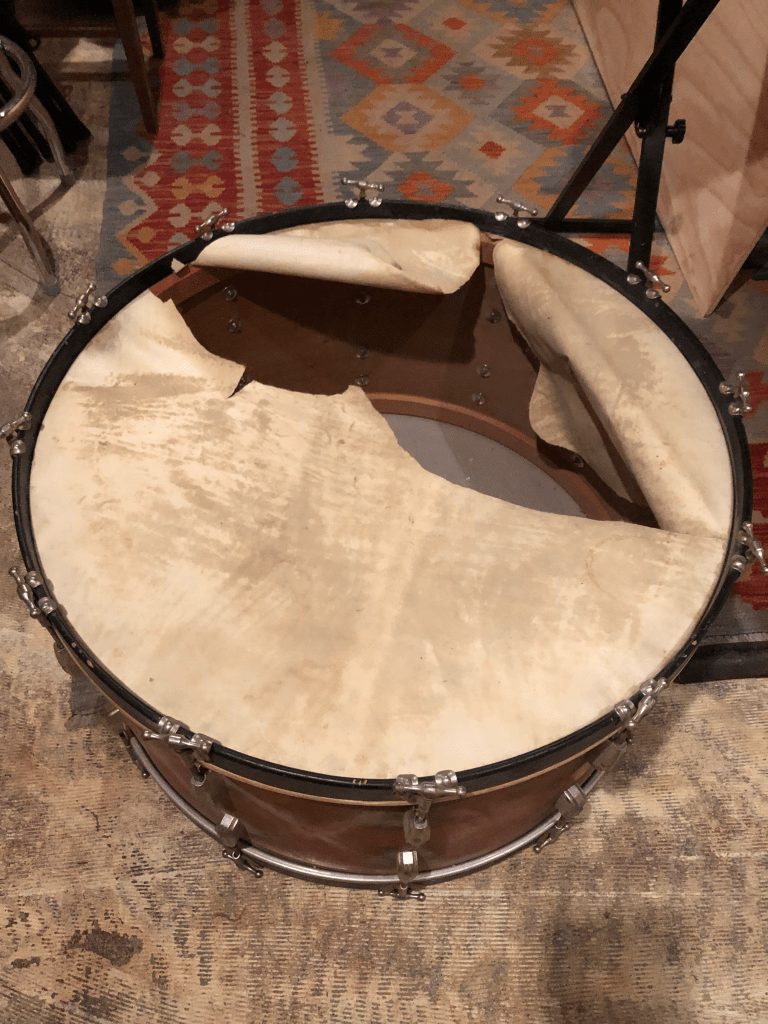
Slipping into parallel parking at a little after 9pm, the turn-of-the-century craftsman style house was already a welcome indicator as to the vintage of this drum. I casually ambled up the path and steps to greet the owner and in a very warm and welcoming manner, he invited me into the front room to view the drum. On closer inspection, the tension rods and lugs were definitely either early or mid-20th century, despite their encrusted rust, and grimy muted metal plating. “They don’t make them like they used to…” I may have blurted out, or was it just the thought passing through my fatigued mind. With some hemming and hawing, I outstretched my hand with a crisp fifty dollar bill and the deal was done. Carrying it off to my van, I opened up the latch on the trunk and grabbed my flashlight. Lo and behold, the badge, obscured by deep, rusty orange paint, read: “Slingerland, Chicago, ILL.” The excitement churned up from the bottom of my belly. I hopped into the driver’s seat and took off into the night, exhilarated by the “find” and already scheming about ways to restore this relic to its former glory.
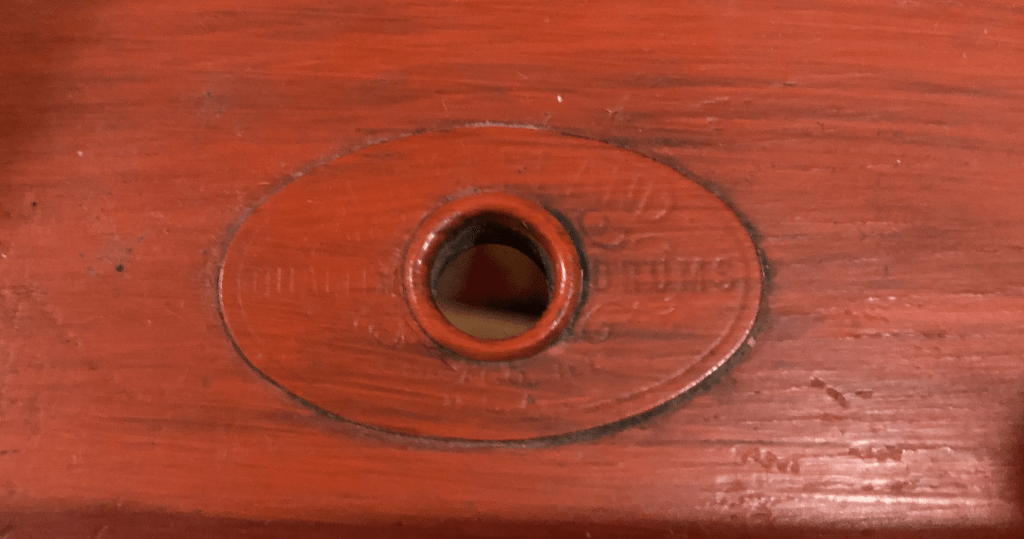
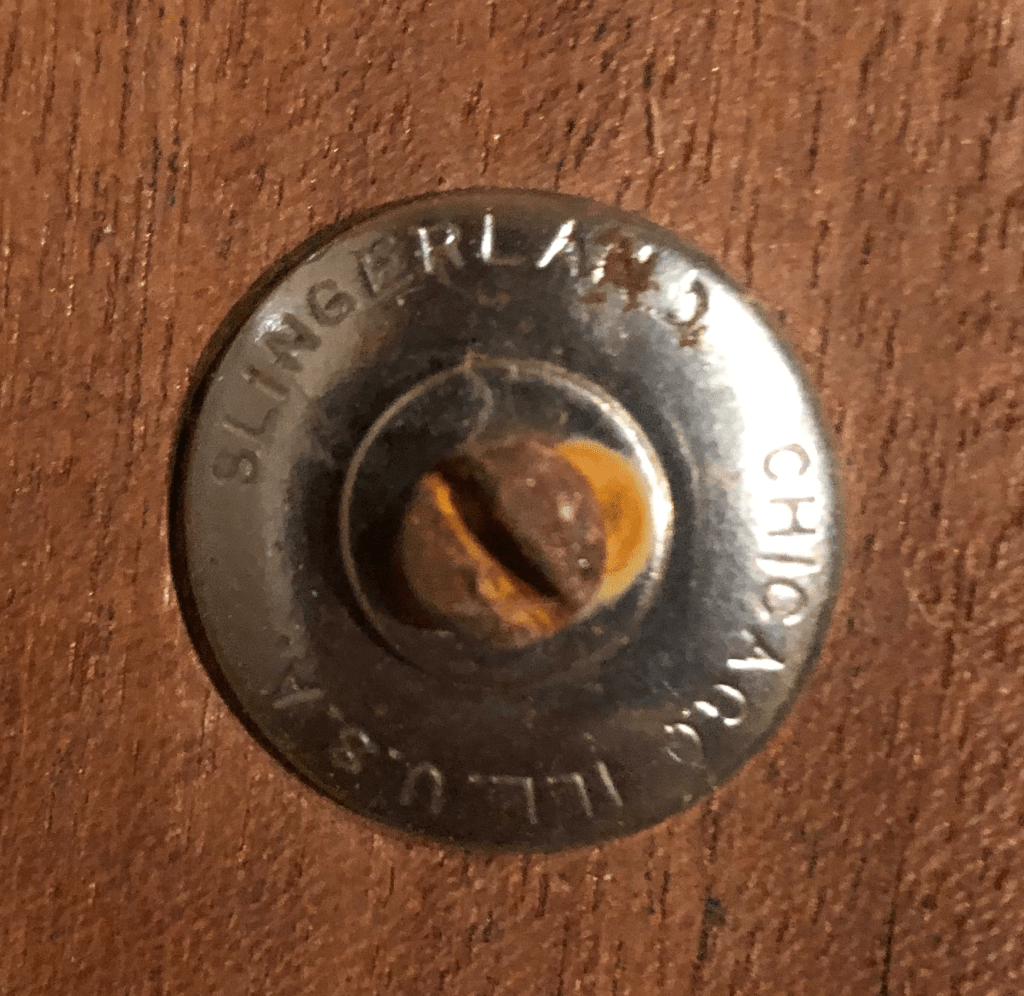
Arriving home sometime around midnight, the excitement had transformed into a more focused energy of discovery. Gathering clues as to its age and vintage, the usual identifiers (lugs, tension rods, badge design, and spectacularly, convex rounded washers that read “Slingerland, Chicago ILL. U.S.A.” situated on each lug mounting screw. What incredible craftsmanship! Few details were left out of the design and manufacture of this instrument.
Needless to say, the dimensions of this drum were something that initially enticed me–28″ diameter by 14″ depth of shell. Immediately, images of John Bohnam and Levon Helm whipped through my brain at a million miles a second. “Could this be the ticket to authentically playing a version of Immigrant Song or Achilles Last Stand?” “Could the bluesy roots music of one of Arkansas’s (via Canada’s) shining stars be at my toes (right foot)”? Time would tell. Shell dimensions aside, the heads desperately needed to be replaced.
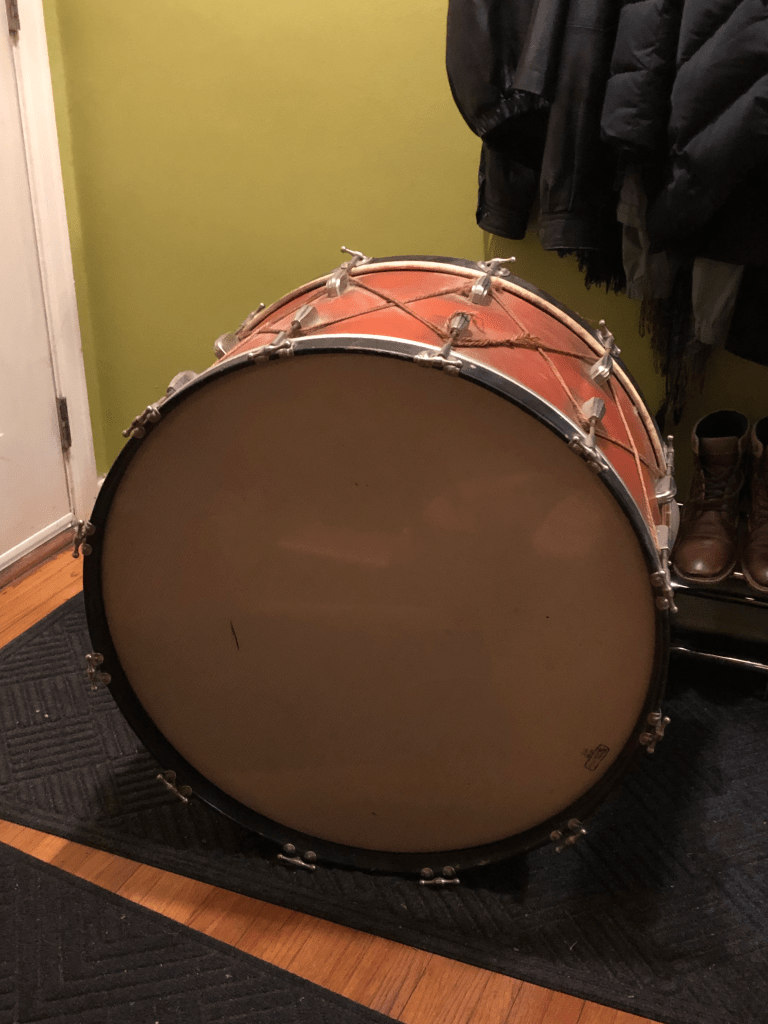
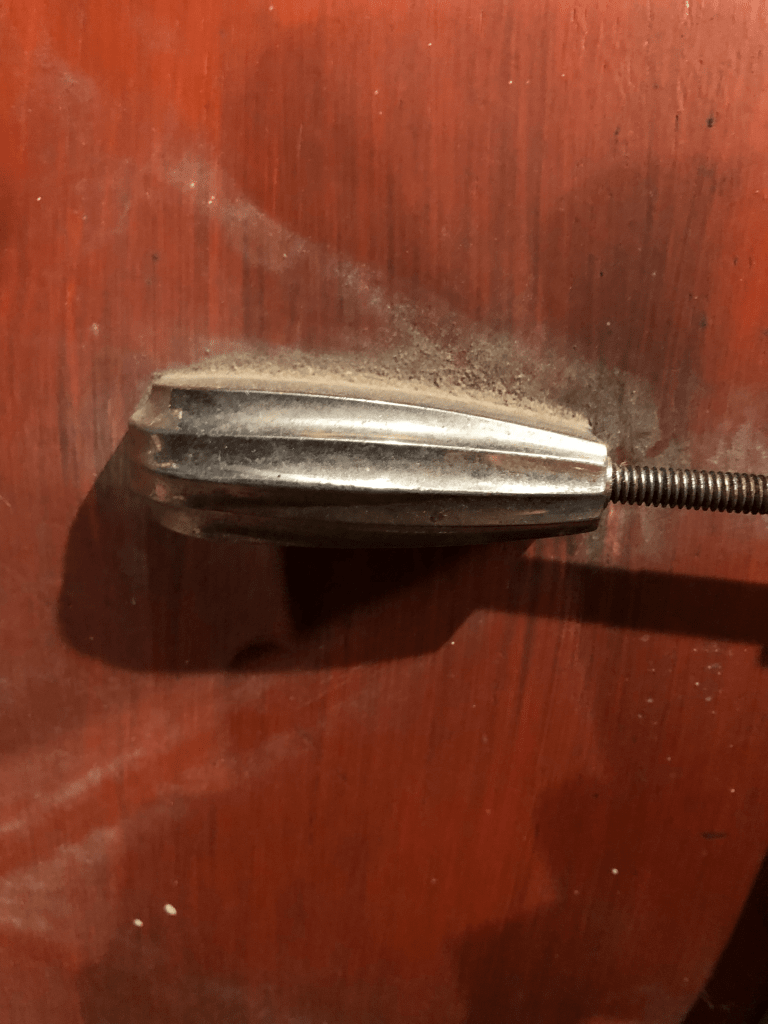
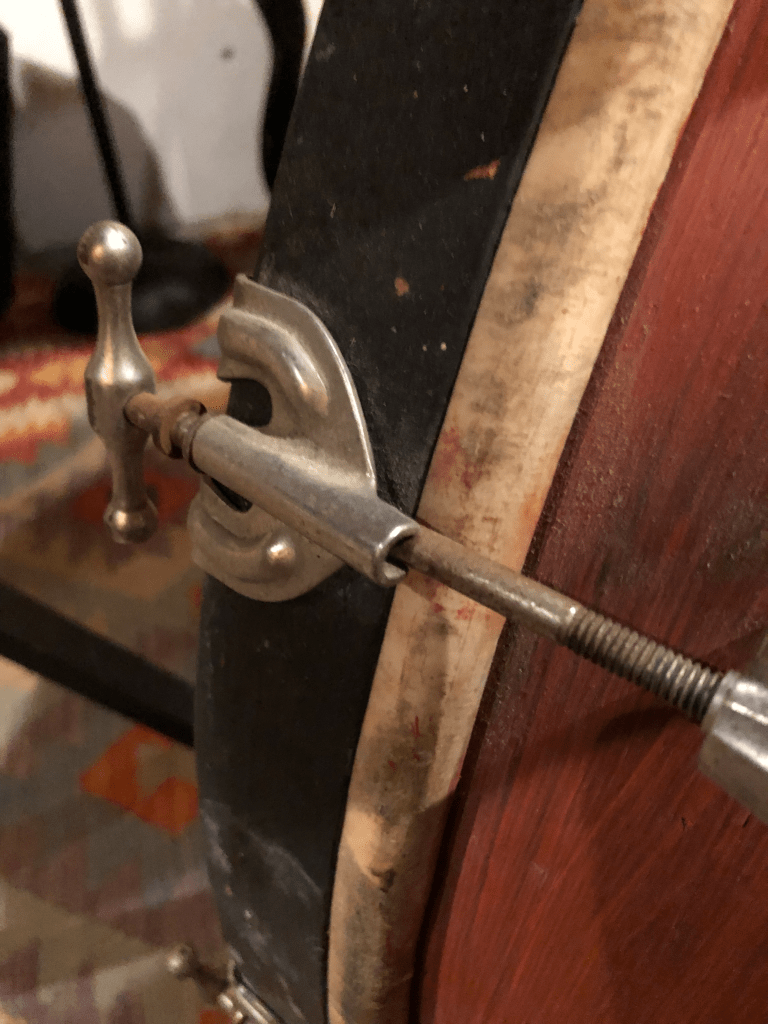
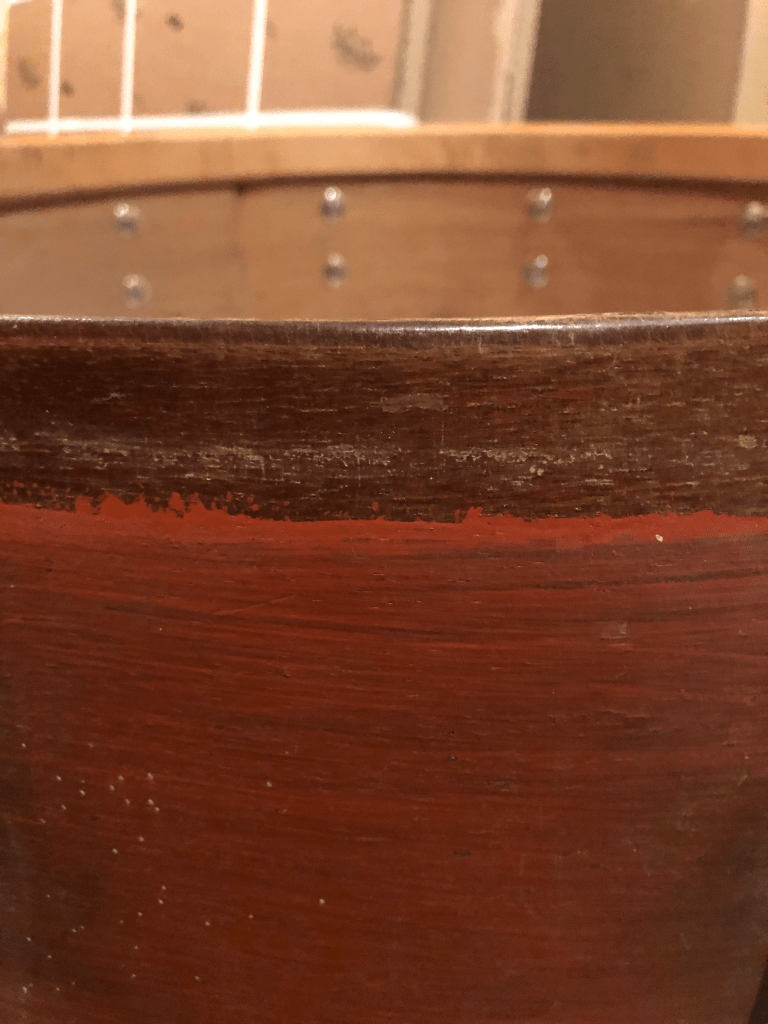
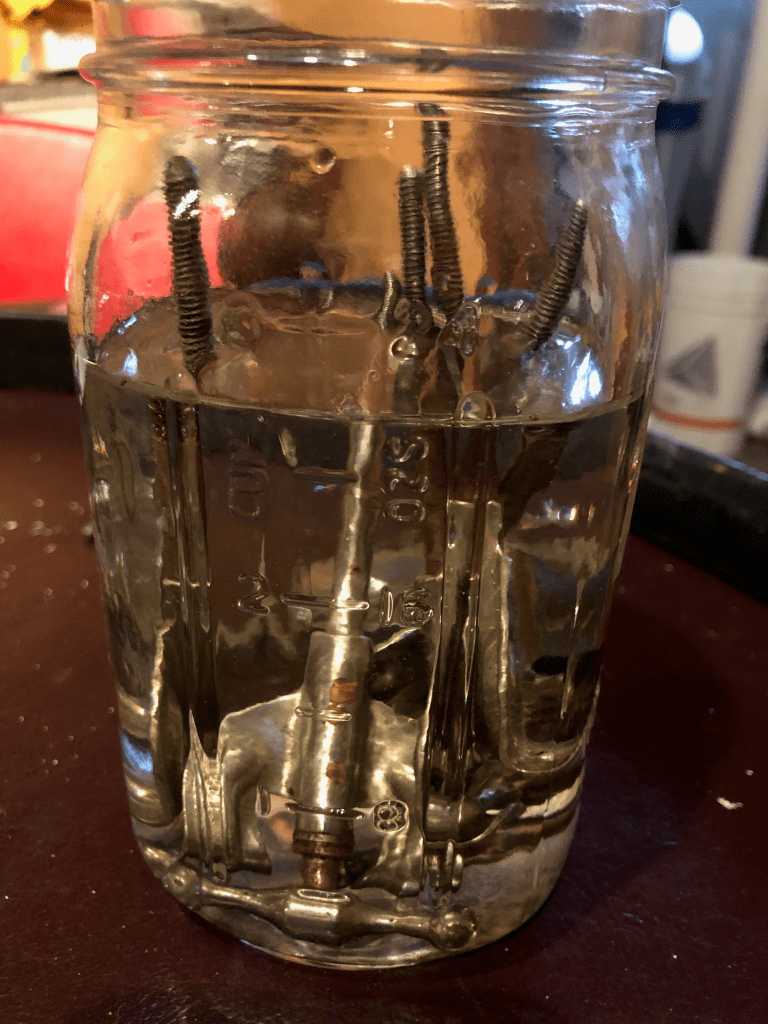
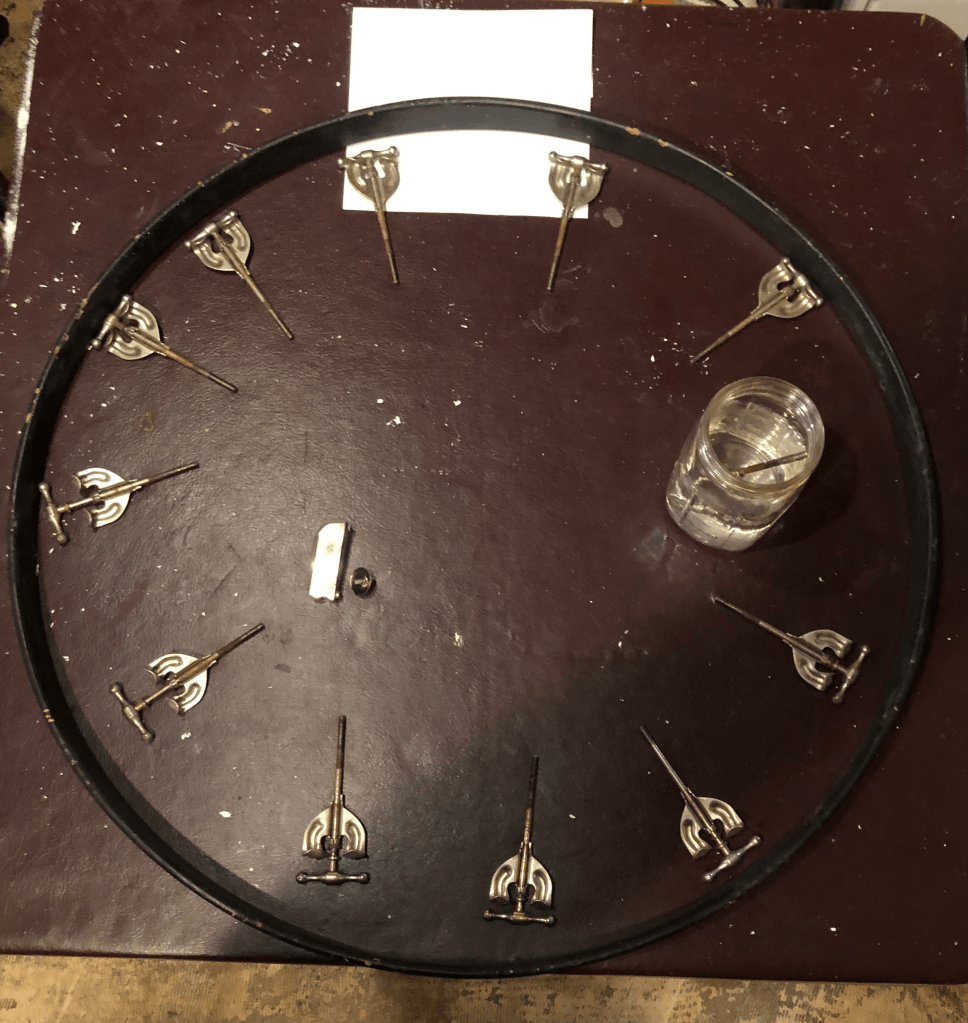
Top left: Rope was passed through the gaps of the tension rods and lugs. Top middle: beavertail lugs. *Thwap*. Top right: tension rod t-arms pass through a cuff on the inside of the claw. Cool design feature! Bottom left: Mahogany? Yes, indeed… Bottom right: Tension rods getting a bath.
While it was definitely in need of a deep cleaning, I could not contain my excitement about putting it back into playing condition. With drumheads on order (that is, “concert” bass drum heads, as there are no drum set specific heads for a drum of this diameter), I eagerly awaited their arrival and busied myself with cleaning tension rods and the shell. Also on order, was Rob Cook’s book detailing the history of Slingerland drums, one of the keys to dating this instrument. And until that arrived, I could only hope that the exposed wood just below the bearing edge was indeed an indicator of mahogany shell composition.
…and then the heads arrived. And slowly, Rob Cook’s book was carried by the postal worker to my door. Excitedly cracking open the text, I immediately scanned the table of contents for the section on dating, aptly titled “Slingerland Dating Guide”. With some flipping, perusing, and acquainting myself with the drum manufacturer’s lexicon, it looked indeed like a drum of this vintage–with the badge and beavertail lugs–was manufactured some time between 1945 to 1955. Because the original finish had been painted over, my best guess was that the shell composition was the following: mahogany inside ply, mahogany outside ply (or laminate), and poplar middle ply. That’s right, a three-ply shell with reinforcement rings around the bearing edges. Again, “they don’t make them like they used to…” And then, the heads arrived… now time to play this drum!
I played the bookends of Moby Dick from memory, and then played my own solo. Wow! What a sound out of this drum! A hard felt beater on the bass drum pedal seemed a bit too much, so I opted for a sherpa covered mallet/beater to soften the articulation. Still, it packs a punch! I’m not sure I can haul it to every gig, but if for some reason a Trad Jazz or similar gig comes my way, I will be ready…. that or a cover of anything off of Music from Big Pink…
1/9/24
Cage – Composed Improvisation for Snare Drum (Alone)
Late Cage. Really only a couple years before he passed away….
“I didn’t really enjoy it…” What!? “I am not sure that’s relevant here…” well, that’s what I would have said had I not been the guest lecturer in a university music history class. I get it: John Cage is a polarizing figure. Beloved by percussionists, and often dreaded by everyone else. I, for one, have a certain soft spot for process, in performance and composition, so I suppose I am deeply biased. Those that come to music for the enjoyment of the same old tried and true formulae and not expecting to have their expectations dashed, well… they would probably be more at home with the Carpenters or Eagles (both of which I can equally enjoy, by the way). So, the lecture continued with a performance of Cage’s Composed Improvisation for Snare Drum (Alone) by yours truly. I had performed this piece on a previous occasion, so I was excited to revisit it. Speaking of process, this is yet another of his works employing the I Ching, imbuing a mystical process utilizing coin tosses as a catalyst for structural parameters. Fun!
At the performer’s discretion, I availed myself with a broad selection of an appropriately diverse collection of implements. And also, peripheral types of materials that could be applied to the drum. Wood, plastic, metal. But that was basically it. All other choices were made by the coins—or in my case, polyhedral di. Why, you might ask? Well, plainly speaking four-sided di seemed more practical when selecting pararmeters from 64 possible outcomes. And while I could have sprung for the ACTUAL I Ching coins, it was not in the “cards” so to speak.
Here is one of the two performances I have given of this piece:
Now, to give the piece somewhat of a more traditional “arc” I did a little fiddling with the improvisation so that the middle section of the piece functioned more like a slow movement, much like a classical sonata might. To be perfectly honest, the time parameters (that is, working with a stopwatch) provides a very interesting tension between an objective measure of time and the one that is subjectively experienced by the succession of improvised rhythms and textures. And this is not just from a performer’s perspective—I can detect this also within the audience. Depending on your state of mind, you may be completely engaged with the changes happening with implements and concurrently with the sound scape, OR you may feel bored, irritated, or confused by what is taking place in front of you. At the very least, I suppose my goal is to ellicit a response of curiosity. And while this is true for some individuals, I felt both the annoyance and bewilderment churn up from the depths of some peoples’ seats—hence the responses pertaining to “enjoyment”. It all depends on what you find enjoyable, I suppose.
While Cage can mean different things to different people, as a percussionist, he is virtually unavoidable. “Percussion music is revolution,” Cage has said. “Percussion music is a contemporary transition from keyboard-influenced music to the all-sound music of the future [emphasis added].” And well, we’re here! Sounds both percussive and electronic have adorned the tapestry of contemporary music for close to a hundred years. And yet only one of those has its roots in primitive forms of expression. Thus it is this dichotomy (ancient and modern) which, in synthesis, makes Cage both a visionary and iconoclast.
1/12/24
Volleyball
I had the unique opportunity to premiere my improvised game piece “Volleyball” at the University of Northern Iowa New Music Festival on October 30th, 2025. Using a set of cards, different changes (some relatively musically specific, and others more general) occur through the course of a “match” which can be concluded by stopping abruptly, segueing into a coda, or holding a sound and fading out. Here are the three matches that we played at NMF 2025:
11/5/25
Slippery Slope
From the parking lot to the trailhead was a short walk. Then we were scaling up and through granite boulders. At about 8,000 ft., keeping a brisk pace can be a bit of a challenge; especially since we have been “flat landers” for some time now. As the terrain transitions from conifers and boulders to simply boulders upon boulders and rock upon rock, the fissures and cracks of the stone trickle tiny pebbles on the trail, rendering the foot-falls somewhat precarious. Coming over the peak, more of the trail switchbacks down the incline and into a beautiful chain of snow-melt fed lakes–Shealor Lakes; a beautiful moment to be with family. Descending into the basin where the lakes had filled, a kernel of a tune kept spinning through my mind like an ear-worm. Returning to the cabin, I quickly engraved as much of it as possible from memory. Here it is…
 josh hakanson